Saving and investing regularly are two of the most important habits for building wealth. In India, two popular options for disciplined monthly contributions are Recurring Deposits (RDs) and Systematic Investment Plans (SIPs). While both allow you to invest a fixed amount every month, they work very differently and serve different financial goals.
If you are confused about RD vs SIP, this detailed guide will explain the differences, benefits, risks, examples, and practical tips to help you make the right choice.
What Is an RD (Recurring Deposit)?
A Recurring Deposit (RD) is a savings product offered by banks and post offices where you deposit a fixed amount every month for a specific period and earn a fixed rate of interest.
How RD Works
Suppose you invest:
- Monthly Deposit: ₹5,000
- Tenure: 5 Years
- Interest Rate: 7%
You contribute ₹5,000 every month, and at maturity, you receive the deposited amount plus interest.
RDs are considered low-risk because returns are generally fixed and not affected by market fluctuations.
What Is an SIP (Systematic Investment Plan)?
A SIP is a method of investing regularly in mutual funds. Instead of investing a lump sum, you invest a fixed amount every month.
How SIP Works
Suppose you invest:
- Monthly SIP: ₹5,000
- Duration: 10 Years
- Expected Return: 12%
Your money is invested in mutual fund schemes that may invest in stocks, bonds, or other assets.
Returns are not guaranteed and depend on market performance.
RD vs SIP: Quick Comparison
| Feature | RD | SIP |
| Investment Type | Savings Product | Mutual Fund Investment |
| Returns | Fixed | Market-Linked |
| Risk | Very Low | Moderate to High |
| Return Potential | Moderate | Higher |
| Capital Protection | Yes | No |
| Wealth Creation | Limited | Strong |
| Suitable For | Conservative Investors | Long-Term Investors |
| Liquidity | Moderate | Generally Good |
| Inflation Protection | Low | Better |
| Tax Efficiency | Lower | Better (in some cases) |
Key Difference Between RD and SIP
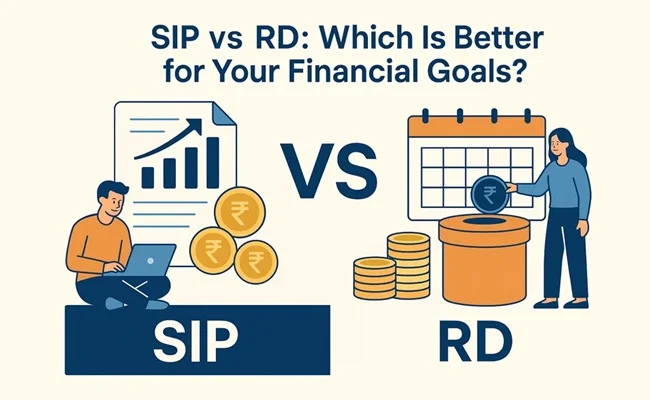
- Nature of Investment
RD
An RD is a deposit scheme where the bank guarantees a fixed return.
SIP
A SIP is an investment route where returns depend on market performance.
Example
₹5,000 monthly invested in:
- RD earns fixed interest.
- SIP earns returns based on mutual fund performance.
- Risk Level
RD Risk
RDs are among the safest investment options available.
Risks are minimal because:
- Returns are fixed.
- Principal is generally secure.
SIP Risk
SIPs carry market risk.
Returns may fluctuate due to:
- Economic conditions
- Stock market movements
- Interest rate changes
- Return Potential
Historically, SIPs have delivered higher long-term returns compared to RDs.
| Investment Option | Typical Annual Return |
| RD | 6%–8% |
| Debt Mutual Fund SIP | 6%–9% |
| Hybrid Fund SIP | 8%–12% |
| Equity Fund SIP | 10%–15%+ |
Past performance does not guarantee future returns.
- Impact of Inflation
Inflation reduces purchasing power over time.
RD Example
If inflation is 6% and your RD earns 7%:
Real return is approximately 1%.
SIP Example
If a diversified equity fund earns 12%:
Real return may be around 6% after inflation.
This is one reason why SIPs are preferred for long-term wealth creation.
- Liquidity
RD
Premature withdrawal is possible but may attract penalties.
SIP
Investors can redeem mutual fund units anytime, subject to fund rules and exit loads.
RD vs SIP Returns Example
Let’s compare monthly investments of ₹5,000.
Scenario 1: RD
| Details | Value |
| Monthly Investment | ₹5,000 |
| Duration | 10 Years |
| Interest Rate | 7% |
| Total Investment | ₹6,00,000 |
| Estimated Maturity Value | Around ₹8.5–₹8.8 Lakh |
Scenario 2: SIP
| Details | Value |
| Monthly Investment | ₹5,000 |
| Duration | 10 Years |
| Expected Return | 12% |
| Total Investment | ₹6,00,000 |
| Estimated Value | Around ₹11–₹12 Lakh |
The difference becomes even larger over longer investment periods.
Benefits of RD
Guaranteed Returns
The biggest advantage is certainty.
You know exactly what you will receive at maturity.
Low Risk
Ideal for conservative investors.
Simple to Understand
No market knowledge is required.
Good for Short-Term Goals
Useful for goals such as:
- Vacation planning
- Emergency savings
- Education expenses within a few years
Benefits of SIP
Wealth Creation
SIPs can generate significant long-term wealth.
Power of Compounding
Returns generate additional returns over time.
Rupee Cost Averaging
When markets fall, SIP buys more units.
When markets rise, SIP buys fewer units.
This helps reduce average investment cost.
Inflation Beating Potential
Equity mutual funds have historically outperformed inflation over long periods.
Risks of RD
| Risk | Impact |
| Inflation Risk | Purchasing power may reduce |
| Taxable Interest | Lower post-tax returns |
| Limited Growth | Wealth creation potential is lower |
| Fixed Returns | Cannot benefit from market growth |
Risks of SIP
| Risk | Impact |
| Market Volatility | Short-term losses possible |
| No Guaranteed Returns | Returns vary |
| Wrong Fund Selection | May affect performance |
| Emotional Investing | Panic selling can hurt returns |
Taxation: RD vs SIP
RD Taxation
- Interest earned is taxable.
- Tax is added to your income.
- Tax is paid according to your income tax slab.
SIP Taxation
Tax treatment depends on the type of mutual fund.
Equity Funds
- Gains held over 1 year qualify as long-term.
- Gains above the applicable exemption limit are taxed.
Debt Funds
Taxation rules vary depending on prevailing regulations.
Tax treatment should be reviewed according to current tax laws.
Who Should Choose an RD?
An RD may be suitable if:
- You want guaranteed returns.
- You have a low-risk appetite.
- Your investment horizon is less than 3 years.
- Capital protection is your priority.
- You are saving for a near-term goal.
Who Should Choose an SIP?
A SIP may be suitable if:
- You want long-term wealth creation.
- You can tolerate market fluctuations.
- Your goal is 5 years or more away.
- You want inflation-beating returns.
- You are planning for retirement or children’s education.
RD vs SIP for Different Financial Goals
| Goal | Better Option |
| Emergency Fund | RD |
| Vacation Fund | RD |
| Wedding After 2 Years | RD |
| House Down Payment (Long-Term) | SIP |
| Child Education | SIP |
| Retirement Planning | SIP |
| Wealth Creation | SIP |
Can You Invest in Both RD and SIP?
Yes. Many financial planners recommend using both.
Example Portfolio
Monthly Savings: ₹15,000
| Investment | Amount |
| RD | ₹5,000 |
| SIP | ₹10,000 |
Benefits:
- Safety from RD
- Growth from SIP
- Better diversification
This balanced approach works well for many Indian families.
Common Mistakes to Avoid
Choosing RD for Long-Term Wealth Creation
RDs provide stability but may not generate sufficient long-term growth.
Stopping SIP During Market Corrections
Market declines often create opportunities for long-term investors.
Ignoring Financial Goals
Investment selection should depend on goals, not just returns.
Not Reviewing Investments
Review your portfolio at least once a year.
Practical Financial Tips for Indian Investors
- Build an emergency fund before starting aggressive investing.
- Use RD for short-term goals and SIP for long-term goals.
- Increase SIP contributions whenever income increases.
- Avoid withdrawing SIP investments during market volatility.
- Diversify across different financial assets.
- Invest consistently rather than trying to time the market.
- Align investments with your risk tolerance and financial goals.
FAQs
Which is better, RD or SIP?
Neither is universally better. RD is better for safety and fixed returns, while SIP is generally better for long-term wealth creation.
Can SIP give negative returns?
Yes, SIP investments can experience short-term losses because they are linked to market performance.
Is RD completely safe?
RDs offered by regulated banks are generally considered very safe, though returns may not beat inflation significantly.
Can I stop an SIP anytime?
Yes, most SIPs can be stopped or modified without major complications.
Is SIP suitable for beginners?
Yes. SIPs are one of the simplest ways for beginners to start investing in mutual funds.
Should I choose RD or SIP for retirement?
For long-term retirement planning, SIPs in suitable mutual funds generally offer better growth potential than RDs.
Conclusion
The difference between RD and SIP comes down to safety versus growth. An RD offers predictable returns and capital protection, making it suitable for short-term goals and conservative investors. A SIP, on the other hand, provides the opportunity to build substantial wealth over the long term through market-linked investments.
For most Indian investors, the ideal strategy is not choosing RD or SIP exclusively but using both wisely. Keep short-term savings and emergency funds in safer instruments like RDs, while investing through SIPs for long-term goals such as retirement, children’s education, and wealth creation. This balanced approach helps achieve financial stability while maximizing growth potential.
Leave a Reply